
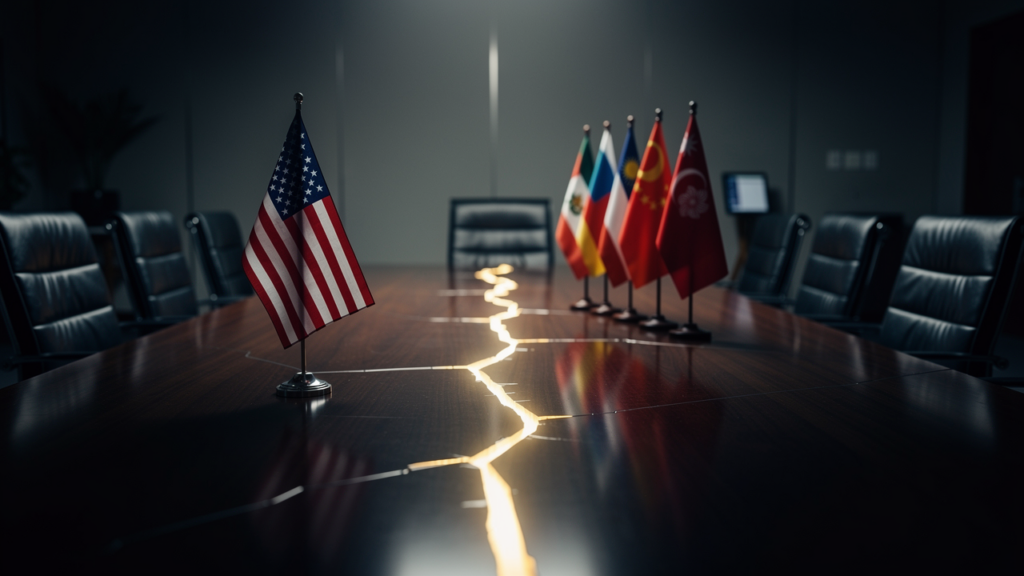
A Supreme Court ruling invalidating the 2025 “Liberation Day” tariffs has unraveled meticulously negotiated trade pacts, leaving export-heavy Asian economies vulnerable to sudden tax hikes.
Export-driven economies across Asia are navigating a renewed period of extreme volatility after the US Supreme Court invalidated a vast swath of President Donald Trump’s 2025 tariffs on Friday. Deprived of his signature economic weapon, Trump instantly pivoted to a 15% universal levy, sending shockwaves through governments that had spent months negotiating tailored trade truces.
The operational reality of the court’s decision materialized on Monday when US Customs suspended the collection of the targeted 2025 tariffs. However, the relief was entirely eclipsed by the realization that Section 122 of the Trade Act would be utilized to impose a 15% flat rate for the next five months, threatening agreements with close allies like the United Kingdom and Australia, which had previously secured favorable 10% rates.
Supply Chains and Strategic Pacts Disrupted
The collateral damage to regional diplomacy is immense. Since the initial tariffs were levied in April 2025, countries have scrambled for exemptions. Taiwan previously absorbed a 15% rate in exchange for massive capital investments in the US, while Indonesia secured a reduction from 32% to 19% just last week. The new universal baseline scrambles the calculus of these agreements.
Sandra Alday, an expert at the University of Sydney, indicated that the macroeconomic impact is guaranteed to inflate retail prices for American consumers. She noted that Asian countries exporting finished consumer goods will absorb the heaviest financial blows, while the mathematics for intermediate goods remains highly convoluted.
Oxford Economics analyst Adam Samdin highlighted the precarious nature of recent diplomacy. Small Asian economies recognize their economic survival is tethered to White House relations, but Samdin stressed that recent deals lack robust legal frameworks. “The current US administration is still looking to enforce higher levels of tariffs, regardless of the measures that have been struck down,” he cautioned.
Diplomatic Strain from Tokyo to Beijing
The whiplash has elicited cautious but critical responses from major capitals. In Tokyo, where Trump met with Prime Minister Sanae Takaichi in October 2025, government officials promised a careful review. But prominent Liberal Democratic Party executive Itsunori Onodera voiced the private fears of many allies, warning that such unpredictable protectionism pushes partners to distance themselves from American influence.
South Korean leader Lee Jae Myung, who also met with the US President last October, faces similar headwinds. South Korea’s Industry Minister Kim Jung-kwan pointed out the massive bureaucratic headache regarding potential refunds for illegal tariffs, though he secured assurances that vital semiconductor exports remain untouched.
In Beijing, the Ministry of Commerce condemned all forms of unilateral tariff hikes, stating the government is conducting a “comprehensive assessment” of the ruling. Despite the friction, US Trade Representative Jamieson Greer confirmed that Trump’s planned April summit with President Xi Jinping remains on track, focusing strictly on agricultural and aerospace procurement.
SOURCES: US Customs, US Trade Representative, China Ministry of Commerce, University of Sydney, Oxford Economics.
This report has been significantly transformed from original source material for journalistic purposes, falling under ‘Fair Use’ doctrine for news reporting. The content is reconstructed to provide original analysis and reporting while preserving the factual essence of the source.