
President Donald Trump’s longest-ever address was characterized by vocal protests, a significant Democratic boycott, and a strategic workaround for federal tariff policies.
President Donald Trump addressed a deeply polarized nation Tuesday night in a speech that set a new record for duration. Facing an audience of millions, the President combined celebratory rhetoric regarding recent athletic achievements with sharp criticism of his political and judicial opponents. The speech arrived as the administration grapples with the fallout of the Supreme Court’s rejection of its trade policies and looming concerns over domestic economic affordability.
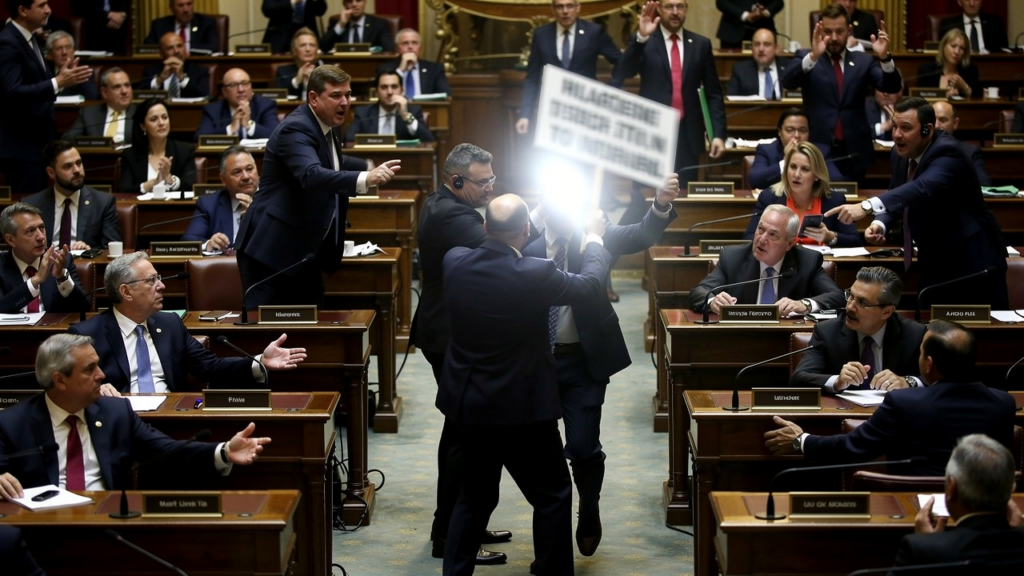
The legislative chamber reflected the nation’s divide, with rows of empty seats highlighting a pre-planned boycott by numerous Democratic members. The tension escalated into physical removals and verbal confrontations. Representative Al Green was escorted out after displaying a sign condemning a controversial video previously shared by the President, while Representative Ilhan Omar vocally labeled the President’s remarks on Somali-American communities as deceptive. Trump dismissed the opposition’s behavior as irrational, frequently pausing his remarks to highlight the lack of bipartisan applause.
“The first duty of the American government is to protect American citizens, not illegal aliens.”
Economic policy took a turn toward executive unilateralism as Trump introduced a 15% tariff to replace those previously invalidated by the Supreme Court. By citing Section 122, the President claimed the authority to maintain these levies for 150 days, asserting that the revenue would eventually facilitate the elimination of income tax. This declaration was made directly to Chief Justice John Roberts and three other justices in attendance, whose presence served as a reminder of the administration’s ongoing struggle with the judicial branch.
SOURCES: U.S. House of Representatives, U.S. Supreme Court, Democratic National Committee, The White House.
This report has been significantly transformed from original source material for journalistic purposes, falling under ‘Fair Use’ doctrine for news reporting. The content is reconstructed to provide original analysis and reporting while preserving the factual essence of the source.