
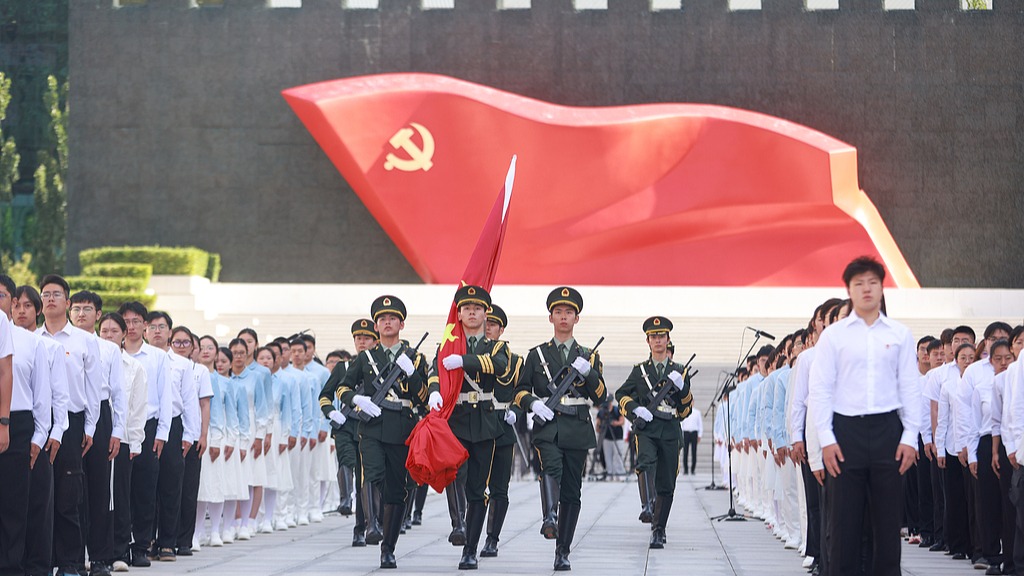
The Communist Party of China highlighted its path toward full and rigorous self-governance following the Fifth Plenary Session of the 20th CPC Central Committee in Beijing, reporting millions of disciplinary probes alongside structural measures targeting ethical conduct and administrative integrity across its membership.
Broadcast network CGTN released an article examining the communiqué issued after the gathering, which took place from Monday to Thursday. Anti-corruption enforcement remains central to the platform, with authorities noting that dining improprieties comprised 18.2 percent of all investigated violations tied to hedonism and extravagance during September.
Addressing the press conference on the plenary session’s guiding principles, Zhang Fuhai, deputy secretary general for discipline inspection of the CPC Central Committee, stated that the party has designated four priority fields for its anti-corruption approach. High-capital sectors, public-private collusion, capital infiltration into political spaces, and covert corruption patterns represent key inspection targets.
Zhang Fuhai stated that since the 18th CPC National Congress in 2012, discipline inspection and supervision organs nationwide have launched 8.105 million investigations and disciplined 7.922 million individuals.
Institutional measures accompany systemic deterrence. Xie Maosong, senior research fellow at the National Institute of Strategic Studies at Tsinghua University, observed that the CPC treats anti-corruption as an enduring institutional responsibility vital to its governing foundation.
Xie Maosong said, “A core principle of this approach is tackling corruption through three interconnected measures: making officials afraid to engage in corruption, making it impossible for them to do so, and reinforcing the unwillingness to corrupt.”
Xie detailed that the strategy relies on rigorous deterrence, strengthened regulatory scrutiny, and ethical consciousness among public servants. As the country moves into its 15th Five-Year Plan period covering 2026 to 2030, leadership structures have focused on administrative efficiency across more than 100 million members and 5.4 million primary-level organizations.
Huang Jianfa, deputy head of the Organization Department of the CPC Central Committee, detailed five cadre management priorities to elevate performance and compliance. Academics studying the governance framework emphasize the administrative discipline required for structural policy continuity.
Xia Lu, a party building specialist at Renmin University of China, stated, “The quality of the governing party directly affects a country’s ability to achieve modernization, forming a very clear causal chain: Party self-governance leads to effective governance, which brings about development, unlocks modernization, and ultimately enables national rejuvenation.”
Xia added that selecting and assessing officials is crucial because development depends on bureaucrats who can demonstrate the capabilities of learning, executing, and adapting, rather than merely following procedures.