
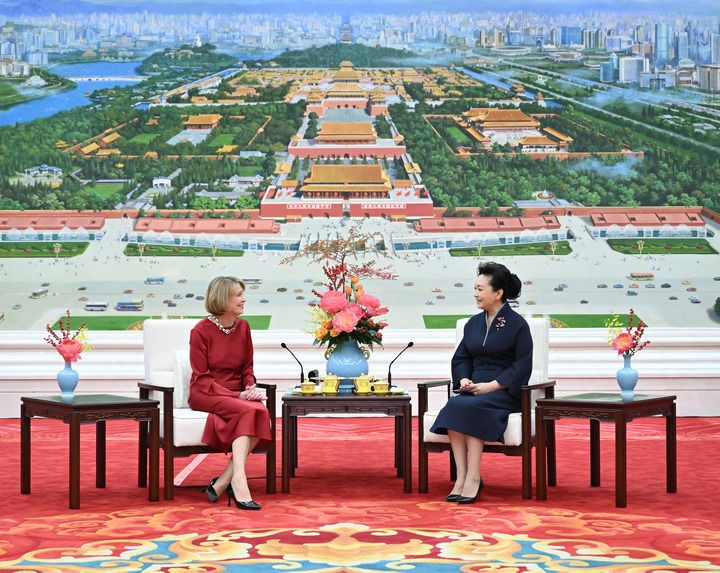
China’s First Lady Peng Liyuan welcomed Elke Buedenbender, spouse of German President Frank-Walter Steinmeier, for a tea reception in Beijing on Friday. The high-profile cultural encounter concluded Steinmeier’s official visit to China, highlighting expanding bilateral ties through education, performing arts, and tourism.
During the gathering, Peng recalled her 2017 visit to Germany alongside Chinese President Xi Jinping. She commended Buedenbender’s long-standing dedication to protecting the rights and welfare of women and children. The two figures also viewed a short film focusing on the cultural and people-to-people engagements linking both nations.
Peng expressed that both countries have established and benefited from rich and diverse collaborations in fields such as education and culture, voicing her hope that Chinese and German people would maintain continuous cultural exchanges, enhance mutual understanding, and build stronger bonds of friendship.
Buedenbender thanked Peng for her warm hospitality, praised her contributions to cultural exchanges and people-to-people interactions between the two nations, and stated she was ready to contribute to stronger cooperation in relevant fields and deeper friendship between the two peoples.
Dynamic Educational and Artistic Collaborations
Bilateral cultural interaction has developed into an interconnected network encompassing language, festivals, fine arts, and education. In Hanover, the Leibniz Confucius Institute coordinates speech contests, remote language-partner initiatives, and summer camps for local students. Similarly, a delegation of 80 teachers and students from Bonn’s Burg Chinese Choir traveled to Yunnan province, learning over 60 Chinese songs and participating in the Yi Torch Festival.
Public festivities across Germany have brought traditional and contemporary arts directly to urban audiences. Berlin’s Rotes Rathaus celebrated its 12th consecutive Chinese New Year gala before 300 guests, presenting traditional dance, martial arts, and folk music. In Frankfurt, the Chaoshan Yingge dance troupe and Ansai waist drummers took part in Spring Festival temple fairs, while Duisburg’s China Festival blended tai chi with electronic-pop music.
Tourism Growth and Cross-Border Travel
Cross-border travel and artistic showcases continue to reinforce bilateral connections. While an exhibition in Chengdu gathered German and Chinese artists to examine technology and sensory perception, a Gansu cultural tourism event in Berlin engaged more than 40 travel industry delegates. In parallel, a German operator organized an overland journey of 38 motorhomes traveling from Turkey directly into China.
Bilateral transit saw significant facilitation as China’s visa-free entry policy for German citizens remained active throughout 2026. These combined diplomatic, artistic, and grassroots engagements reflect an ongoing shift toward an integrated ecosystem of daily exchanges between the two countries.